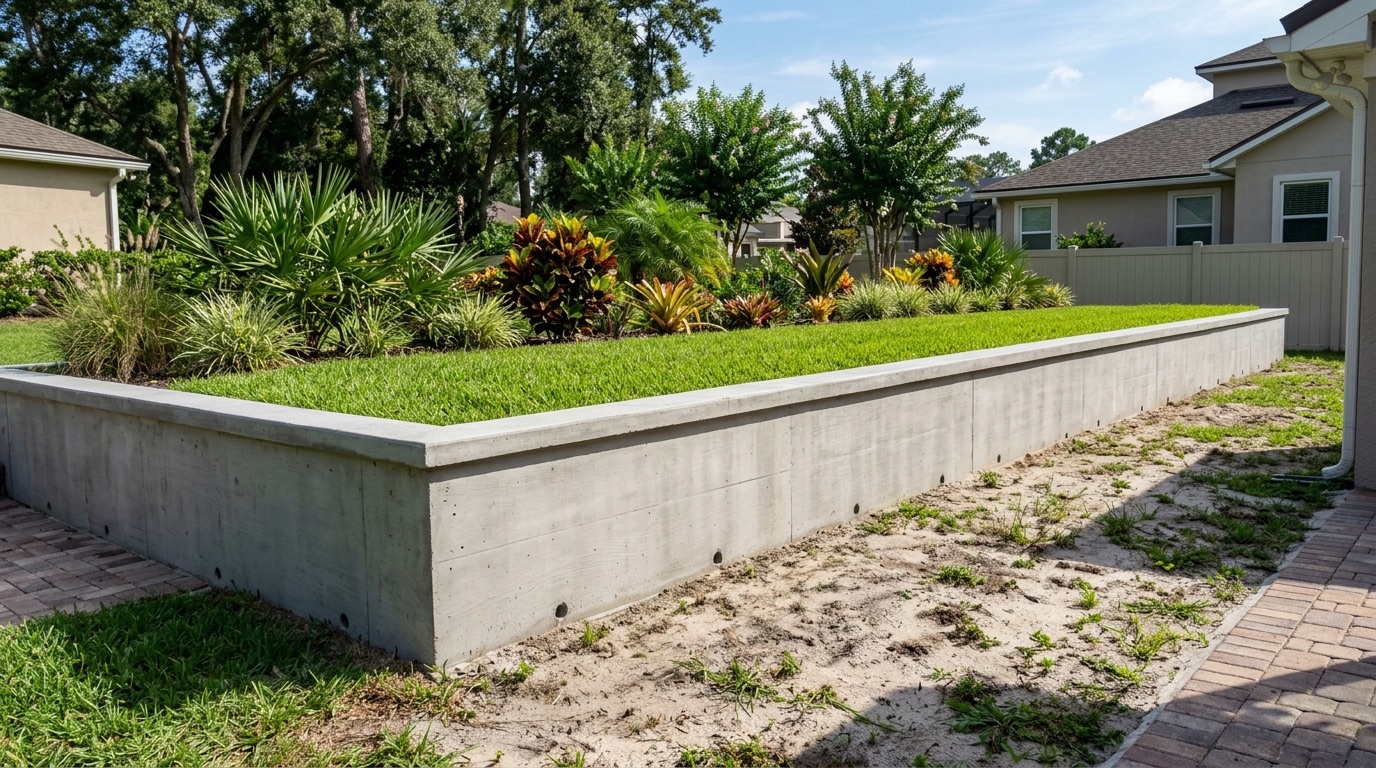
Jacksonville Retaining Walls
Concrete & Masonry Retaining Walls That Hold Ground, Manage Water, and Last in Northeast Florida’s Climate
Jacksonville’s terrain is flatter than most people expect, but grade changes still create real problems — particularly in older neighborhoods where lots were graded poorly, in waterfront properties along the St. Johns River and its tributaries, and in newer developments where cut-and-fill grading has left steep transitions between lots. First Coast Concrete builds retaining walls that solve the underlying drainage and erosion problem, not just the visible symptom. We design and build walls that hold in Florida’s wet season and look right once the job is done.
Concrete Retaining Wall Contractors in Jacksonville
We serve residential homeowners, commercial property managers, HOAs, developers, and landscape contractors across Duval County. Our retaining wall clients include homeowners dealing with yard erosion after heavy rain, commercial property owners managing slope failure near parking areas, and builders who need retaining structures as part of site development. We work with properties of all sizes — from a 20-foot garden wall in Riverside to multi-tier commercial retaining systems on Northside industrial sites.
All retaining wall work is permitted where required by Duval County. Walls over 4 feet in height require a permit and typically an engineer’s stamped design — we handle the permit process and can coordinate with local structural engineers for walls that require stamped drawings.
Our Retaining Wall Services
Our process begins with understanding why the ground is moving and what it will take to stop it permanently:
Site Assessment. We evaluate the slope, soil type, drainage patterns, surcharge loads (what’s above the wall — structures, parking, landscaping), and any existing retaining structures. Jacksonville’s sandy soils drain well but also move easily under saturation — that informs how we detail the drainage behind every wall.
Design & Engineering. For walls under 4 feet, we design from experience. For taller walls or walls retaining significant surcharge loads, we work from stamped structural drawings. We don’t build walls that aren’t sized correctly for the load — undersized retaining walls fail suddenly.
Excavation & Sub-Base. The area is excavated to the footing depth, sub-base is compacted, and the footing (for poured or block walls) is formed and poured on stable bearing.
Wall Construction. Depending on the wall system, we form and pour the concrete stem or lay the block courses, installing rebar at the specified schedule. Drainage aggregate and perforated pipe are placed behind the wall as we build up — never skipped.
Cap & Finish. Exposed tops are capped or finished to match the wall system. Poured concrete walls can be given a smooth, textured, or form-liner finish. Block walls get a capstone course. Drainage outlets are terminated and directed away from the base of the wall.
Retaining Wall Installation & System Types
We build several retaining wall systems depending on the height, load, site conditions, and aesthetic requirements:
Poured Concrete Retaining Walls. The strongest and most durable option for taller walls or walls with significant surcharge loads. Formed and poured monolithically with rebar reinforcement, these walls are permanent structures. Common for commercial applications, road cuts, and residential properties where longevity is the priority.
Concrete Masonry Unit (CMU) Block Walls. Hollow concrete block, fully grouted and reinforced with vertical rebar and horizontal bond beams. A practical and attractive option for residential applications up to 6–8 feet. Can be finished with stucco, tile, stone veneer, or left as exposed masonry.
Segmental Retaining Wall Block. Interlocking segmental block (Allan Block, Versa-Lok, and similar systems) for gravity walls up to approximately 4 feet. Cost-effective for garden walls, landscape terracing, and low slope retention. No mortar required; held by weight, batter, and geogrid when needed for taller applications.
Timber & Railroad Tie Walls (Replacement). If you have an existing timber retaining wall that has failed or rotted — very common in Jacksonville neighborhoods from the 1980s and 1990s — we remove the old wall and replace it with a concrete or CMU system that won’t rot.
Deadman & Geogrid Systems. For taller segmental block walls, geogrid reinforcement is installed in horizontal layers behind the wall to tie the wall face into the retained soil mass. Required by engineering for walls over 4 feet in poor soil conditions.
Retaining Wall Repair & Reconstruction
Retaining walls fail in specific ways in Northeast Florida. We see leaning walls caused by hydrostatic pressure buildup behind walls with blocked drainage; cracked poured walls from root intrusion or footing settlement; spalling CMU block from freeze-thaw (rare here but happens during hard freezes); and timber wall rot that has progressed to the point of structural failure.
Repairs we handle:
- Drainage remediation — excavating behind a failed wall to clear clogged drains and add perforated pipe properly. Many wall failures in Jacksonville are drainage failures in disguise.
- Tiebacks and anchors — for walls that have shifted but are otherwise structurally sound, we can add tiebacks drilled through the wall into stable soil behind to arrest movement.
- Section reconstruction — failed sections are demolished, sub-base is rebuilt, and a new section is constructed to match the existing wall.
- Full replacement — older timber or poorly constructed walls are demolished and rebuilt with a properly engineered concrete or masonry system.
- Crack injection — active cracks in poured concrete walls are routed and injected with polyurethane or epoxy to restore waterproofing and structural continuity.
Why Jacksonville Property Owners Choose First Coast Concrete
Licensed, Insured & Permitted. We handle all Duval County permit filings for walls that require one. Every crew member on your property is covered under our general liability and workers’ comp policies. You don’t have to worry about exposure.
Free On-Site Estimates. Retaining wall quotes depend on height, length, soil conditions, drainage requirements, and the wall system you choose. We come to your property, walk the site, and put together a written quote specific to your conditions. No charge for the estimate.
Local Drainage Knowledge. Jacksonville’s rainfall intensity — especially during Atlantic hurricane season and the summer afternoon thunderstorm season — puts retaining walls under more hydrostatic stress than most contractors account for. We design drainage systems behind our walls for Florida rainfall, not average national rainfall. That difference is why our walls don’t push out.
How to Get a Quote
- Call or contact us — 904-944-6263 or our online contact form
- Schedule a site visit — we walk the slope, assess soil and drainage, and measure the wall extent
- Receive a written quote — wall system options, drainage detail, permit requirements, and timeline
- Review and schedule — we get you on the build calendar once you confirm
For slopes that are actively eroding, we can prioritize site visits. Call 904-944-6263 and let us know the urgency.
Frequently Asked Questions — Concrete Retaining Wall Jacksonville FL
How tall can a retaining wall be without a permit in Jacksonville? Duval County generally requires a permit for retaining walls over 4 feet in height measured from the bottom of the footing. Walls under 4 feet in most residential applications may not require a permit, but setback rules, HOA requirements, and proximity to property lines can add conditions. We evaluate permit requirements during our site visit and handle all filings for walls that require one.
What is the best type of retaining wall for Jacksonville soil? It depends on the wall height and load. For garden walls and low slopes under 3 feet, segmental block is cost-effective and easy to integrate with landscaping. For taller applications or walls retaining parking areas or structures, poured concrete or reinforced CMU block are the better long-term systems. Jacksonville’s sandy soils drain well, which reduces hydrostatic pressure behind walls — but they also erode quickly without proper drainage detailing behind the wall face.
Why do retaining walls fail in Florida? The most common cause is inadequate drainage behind the wall. When water saturates the retained soil and has nowhere to go, hydrostatic pressure builds until the wall overturns or slides. Our walls include perforated drain pipe, drainage aggregate, and daylight outlets as standard. The second most common cause is undersized footings that settle in sandy soil — we size footings based on actual load calculations, not rule of thumb.
How long does it take to build a retaining wall in Jacksonville? A typical residential retaining wall — say 40 to 60 linear feet at 4 to 5 feet tall — takes 3 to 5 working days once materials are on site. Permit processing adds time for walls over 4 feet. We give accurate timelines during the quote process based on your specific scope.
Areas We Serve
First Coast Concrete builds retaining walls throughout the Jacksonville metro area, including:
Jacksonville neighborhoods: Riverside, Avondale, Ortega, San Marco, Mandarin, Murray Hill, Springfield, San Jose, Southside, Arlington, Northside, Westside, Baymeadows, Regency, Deerwood, Downtown Jacksonville
Surrounding cities and communities: Orange Park, Fleming Island, Middleburg, Green Cove Springs, Ponte Vedra Beach, St. Johns, Nocatee, Yulee, Fernandina Beach, Callahan, St. Augustine, Palm Valley
We serve all of Duval County and regularly work in Clay, St. Johns, Nassau, and Baker counties. Call 904-944-6263 to schedule your on-site assessment.